
Every minute, every match: Jessie Fleming carried the Thorns through 2026
1 day ago
5 min read
By Karinna Leonard | November 9, 2026

Jessie Fleming spent 2,700 minutes on the pitch for the Portland Thorns FC this season, every second of the National Women's Soccer League (NWSL) regular season. That made her one of eight players in the league’s Iron Women Class of 2026.
The minutes are only a small part of it. In a turbulent season, Fleming has been the most important and most consistent player on the roster. She finished with one goal and two assists, but merely looking at the numbers misses what Fleming truly does for the team. Next to Nina Nijstad, Fleming anchors the Thorns’ midfield as their deep-lying, box-to-box presence, reading the field in a way that stops attacks before they even happen.
After the Thorns’ Aug. 22 match against the Denver Summit at Providence Park, I asked head coach Robert Vilahamn what it means to have a player like her. He started with the space in front of the back line, which Fleming and Nijstad cover together. “I think if you look at Jessie Fleming and Nina Nijstad as well, how they have this space in front of our back line, it's crucial for us. If they don't do that, then they're going to give up the longer attacks,” he said. When the pair hold that space, Portland can force opponents outside and trust its fullbacks. “And they're also so good on the ball to connect and do this,” he said.
He finished with a line that sums up her season as a whole: “Jessie has played all the minutes so far, and she's just a machine who just keeps going and keeps going. So I'm very happy to have her on my team.”
She continued playing every minute after that night, too, and the Thorns needed it. Before the season, midfielder Sam Coffey left for Manchester City in the Women’s Super League.
In August, Olivia Moultrie tore her right ACL, ending her season. Together, those two losses left the midfield decimated, and Fleming stepped up at every turn. She is a key reason Portland made the playoffs, going 14-8-8 to claim sixth in the standings.
Beyond the box score, the advanced numbers back up what Vilahamn sees in Fleming, protecting the space in front of the back line and connecting the team on the ball. She completed 976 passes this season at an elite 81.8% success clip, doing so in the crowded central channels where turnovers are most costly and common.
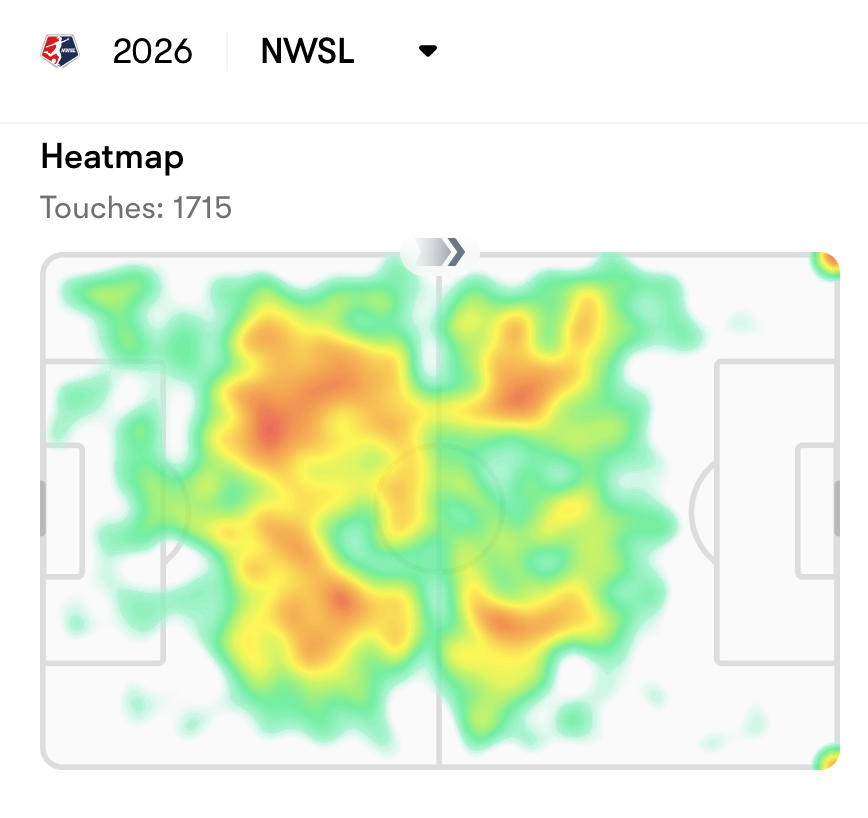
Her expected assists sit at 0.13 per 90, which ranks in the 86th percentile of the league, and she ranks in the 88th percentile among NWSL midfielders in chances created.
Fleming also places in the 75th percentile for defensive contributions. That combination makes her a world-class midfielder, as she connects the team going forward and protects it going back. A stat line of one goal and two assists can’t capture that, but the underlying numbers do.
Her teammates see it, too. forward Pietra Tordin said last season, “Someone that really inspires me is Jessie Fleming. You will not see her jogging on the field; she is sprinting everywhere. Before I step on, I want to play like Jessie. If I'm out there sprinting like her, I'll do great. I use that when I come off the field as well.”

Rookie midfielder Shae Harvey saw it up close after the team’s Oct. 3 loss to the Boston Legacy. With the Thorns chasing the playoffs and trailing 3-1, Harvey scored her first goal for the club, and Fleming jumped into her arms to celebrate, determined to reward the effort despite the final 4-2 result. “Jessie leads by example,” Harvey said afterward. “But she’s also super intentional as a leader. I feel like she always knows what the team needs, what the individuals around her need, and she always pulls someone up when they need it. So she’s a great leader, one of the best.”
None of this is new. Fleming has been doing it since she was 15, when she became one of the youngest players ever to debut for Canada’s senior team on Dec. 15, 2013.
A native of London, Ontario, she grew up learning from Christine Sinclair, arguably the greatest Canadian player of all time, Canada’s captain from 2006 until 2023 and the Thorns’ captain for 12 seasons. After Canada’s quarterfinal win at the 2020 Tokyo Olympics (held in 2021), Sinclair suggested Fleming take over penalty duties.
Fleming went on to score the lone goal in the semifinal against the United States with a penalty kick, equalized against Sweden in the final with another PK, and scored the first penalty of the shootout that won Canada its first Olympic gold. During the tournament, Fleming played 555 minutes, the second most for Canada.


Comments