%20copy.png)
The Feeling That Never Left: From Stands to Screen, Loss to Purpose, and Everything In Between
Apr 9
8 min read
Updated: Apr 13
by Holly Arend | April 9 2026

Annie O’Donnell grew up in ice rinks in Southern California. Not on the ice, but in the stands, in the hallways, hanging around during those long gaps between games when you are just waiting. More time at the rink than at the beach, even though she was a San Diego kid. That is where she learned about competition and community, but also about people and herself.
She comes from a big hockey family. Five kids, four brothers who all played travel hockey. That meant early mornings, long drives up and down Southern California, holidays on the road. Her parents were the type to hide Easter eggs in hotel rooms and lobbies so the holiday still felt like a holiday, even if it was wrapped around a tournament. The same families moved up together through different age groups, so it was not just a sport; it was a whole little world.
“I say I was born in it, molded by it, and that is pretty true,” O’Donnell said.
She did play when she was younger, but eventually lost interest. All her brothers were in hockey and she wanted her own thing. She jokes about having heavy Aquarius placements, about always wanting to differentiate herself. So she tried other sports, leaned into other interests, but she never stopped being a hockey fan. Even when she was not playing, she knew she wanted to work in the game somehow. She just did not know what that job would be.

In high school, she thought athletic training might be the path, mostly because she admired her school’s trainer. Then she looked at the reality of the classes she would need, imagined a future in khakis and a polo on the sideline, and changed course. Science heavy, not her. Khaki pants, also not hers.
She ended up studying sports marketing at Duquesne University in Pittsburgh. That got her internships with the Los Angeles Kings and the Pittsburgh Penguins. With the Kings, she worked in community relations, the side of hockey that handles charity events, autograph items for auctions, and all the behind-the-scenes stuff fans take for granted. Tables full of players signing until their hands hurt, staff and interns trying to tie up loose ends around game schedules, trades, travel, everything. It was fun and eye-opening, but it also stripped away the idea that working for a team was some glamorous dream.

Her internship with the Penguins was in youth and amateur hockey, helping with things like Sidney Crosby’s Little Penguins program, where kids got gear to try the sport. She worked game nights, helped run tournaments, and saw again how many people it takes just to keep things moving. She was grateful for those experiences. They also convinced her that a front office job was not her long-term future. Long hours, low pay, feeling like you had to fit into a certain mold and not get too “excited” about anything. That did not match how she wanted to show up.
“I think being a fan is cool. I think being excited about things is cool,” she said.
After college, she ran into the same brick wall a lot of people hit. Entry-level sports jobs did not pay enough to live on, especially if she did not want to move back home. So she took an inside sales job in Chicago. The work was not a dream, but she loved the city. She told herself she would keep looking for sports jobs and pivot when she could.
A promotion moved her to New York. On paper, that looked like progress. In reality, the job itself was rough. The environment was toxic, the work left her drained, and she spent a lot of time staring out the office window wondering when things would change. That period still anchors her sense of what she will and will not tolerate.
“It’s not worth it to do a job that you hate for 40 plus hours a week where you’re mistreated,” she said.
Eventually, the company started cutting costs and her job was eliminated. It was scary, but it also felt like a reset. She suddenly had a blank slate and a chance to do something that actually interested her. Podcasts were having a moment, so in November 2019 she launched one. At first, she did not want to niche down. She talked about sports in general, whatever she found interesting.
Then the pandemic hit. Sports shut down, seasons paused, and like everyone else, she got on TikTok. In her tiny Upper East Side apartment, she set up her phone and started talking to it. About hockey, about sports stories, about whatever was happening. When the NHL returned for the bubble playoffs, her content really started to pick up. There were not many people doing what she was doing in hockey, and her voice felt different.

“I make content that I want to see,” she said.
Over time she narrowed her focus. She still watches football. She is still a big Dodgers fan. But as a creator, she saw the value in building a specific lane. She leaned into hockey, tested ideas, watched what worked, and learned what did not. She makes things she likes first, then adapts based on what her audience responds to. The trial and error is part of it.
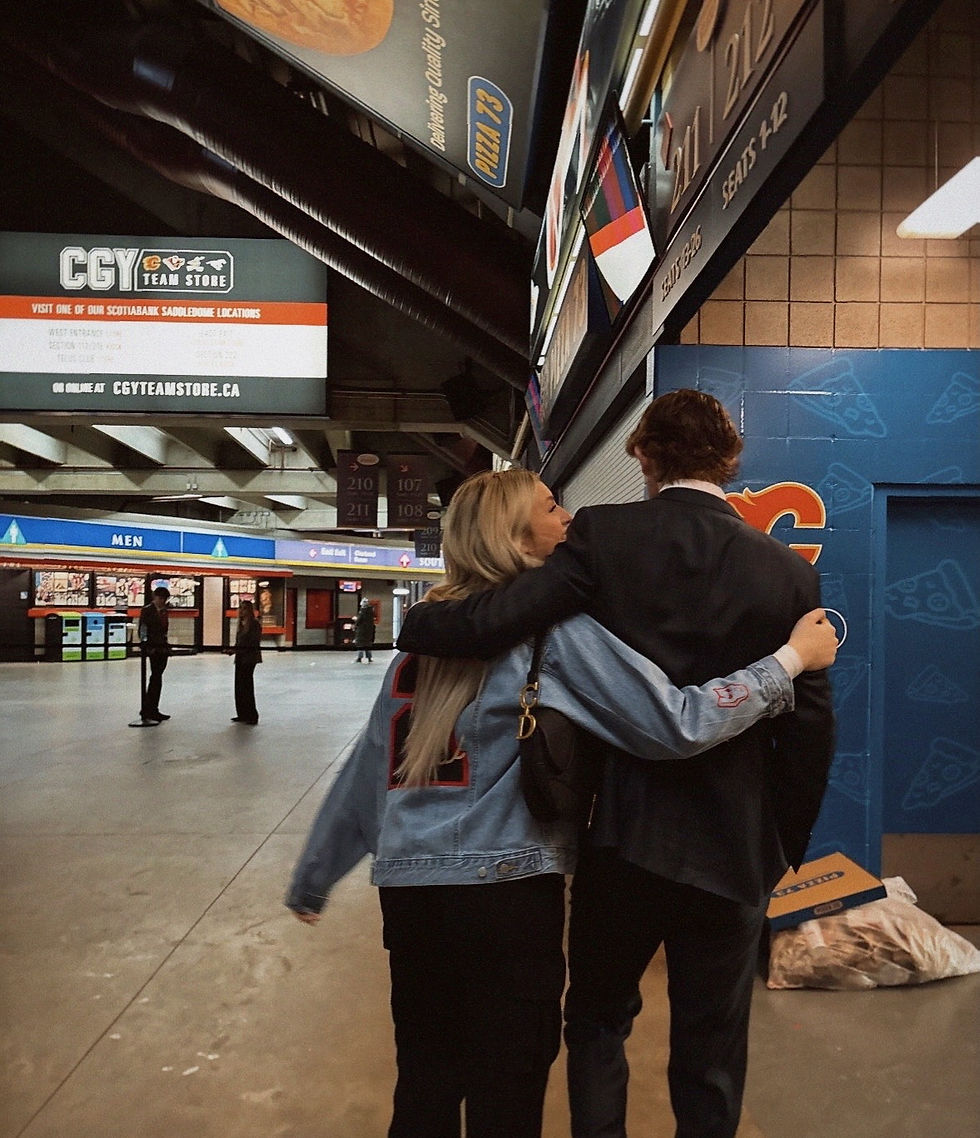
Her style became one of the most recognizable parts of her presence. People tuned in to hear her talk about the game, but they also wanted to see what she would wear on a game day or what she would say about player outfits. She gravitates toward vintage pieces, leather, rock influences, and looks that do not blend into the crowd. She is not trying to dress like every other fan in a jersey and sneakers.
“I don’t like showing up places looking like everybody else,” she said.
To actually make the outfits she pictured, she started teaching herself to sew. Thrifted pieces became raw materials. She took ideas from her head and turned them into real clothes, including a leather set inspired by motorcycles that she put together entirely on her own. Having a vision is one thing. Following it all the way through is another.
“One thing I pride myself on is when I have a vision, I execute it,” she said.
The more she immersed herself in that side of the game, the more obvious it was how limited the options had been for women for so long. If something was “for women,” it usually meant a pink jersey or a fitted V-neck that did not actually fit real human bodies. It felt like an afterthought, not an invitation.
“It was pink jerseys or things that didn’t actually fit women,” she said.

By building her own looks and putting them online, she was quietly rewriting what a hockey fan could look like. A woman who knows the game, cares about the culture, loves rock music, and dresses in a way that feels aligned with all of that. She is not trying to be the “cool girl” who does not care. She is very clear that she does care.
“I think being excited about things is cool,” she said.
Her urge to be distinct runs deeper than clothes. As a kid, it showed up in how she drifted toward other sports just to carve out space that was not already occupied by her brothers. As an adult, it shows up in the way she approaches content. She is open about her interests, about grief, about music and life outside scores and stats. She wants people to see something in her that reflects something in themselves, whether that is a love of hockey, a love of rock, or figuring out how to live with loss.
She is clear that it is okay to change your mind, okay to “hold the L” when a take ages badly, okay to learn publicly. In a sports world where people cling to old opinions out of pride, she sees a lot of value in staying teachable.

Hockey, for her, is also inseparable from her youngest brother, Paddy. He was the goalie in the family, the youngest of the five kids, the one her dad actually allowed to try the position because he thought Paddy could handle the mental side of it. A lot of kids say they want to wear the pads once they see the gear. Paddy was different. He stuck with it.
He played his youth hockey in San Diego and eventually went on to play at the University of Utah. He was more than just a goalie. He was the funniest person she knew, the one with weird, specific interests. He loved Star Wars and space, had a YouTube channel where he edited gaming videos, and kept a friend group that did not all look the same or like the same things. Hockey guys, anime kids, rock climbers, all mixed together. That range said a lot about him.
Before his junior year, he had a seizure. Doctors found glioblastoma, a terminal brain cancer with no cure right now. They gave him six months.
“He wanted to inspire people,” O’Donnell said.

Paddy chose how he was going to respond. He turned toward faith and community. He wanted people with his diagnosis, or with any heavy thing in their life, to know that you can still move forward. You can still live, still find joy, even when you are limited.
He became partially paralyzed on his left side and had to wear a medical device on his head. None of that stopped him from trying to live the way he wanted. He went out with friends. He showed up to games. He did his best to keep being himself. “He still wanted to do everything,” she said.
One of the things that meant a lot to him during that time was his friendship with Anaheim Ducks goalie Lukas Dostal. Connecting with an NHL goalie made him feel like he was still part of the position he loved, like he had not lost that piece of himself.
“He felt like a goalie again,” she said.
Paddy passed at 23. His loss sits inside everything O’Donnell does, but so does his influence. Watching him confront rock bottom and still choose to live in the way he could reshaped how she thinks about her own life and risks.
“They say the benefit of rock bottom is there’s no place but up,” she said. “And it is the easiest place to rebuild.”
She remembers being unemployed, heartbroken, unsure what was next, and realizing that settling had already shown her what that felt like. She did not want to go back to that. Fear of what people might think had kept her from fully committing before. At some point she decided she was not going to let imagined opinions stop her from doing what she felt she was here to do.
“Sometimes you just have to jump,” she said. “You are never going to feel fully ready.”


Such a good article. Hoping that you make a hockey fan content empire, Annie
Go Annie go!!!! Great article. Great person! And great family! Best of luck on your life adventure and keep excelling at life!!! Look forward to more stories.
What an awesome story! You go! Been a hockey fan my whole life (RPI in Troy, NY) with my parents and now for the last 43 years with my husband. Love the mention of the smell of the ice and sounds of pucks and sticks.
You tell your story in your way and more will find the love of hockey too!
So proud of our Annie. Her Paddy would be the first to recognize and salute her determination, grit, and commitment. Future is bright with the best yet to come. 👍😘