%20copy.png)
The Next Big Change in College Sports Isn’t NIL - It’s Eligibility
Aug 26
7 min read
by Whitney Randall | August 26 2026

College athletics has undergone more change in the past five years than any other period in National Collegiate Athletic Association history.
Name, Image and Likeness (NIL) has allowed athletes to profit from their personal brands. The transfer portal has transformed how athletes move between programs. Conference realignment has reshaped historic rivalries and created new power structures across college sports. Meanwhile, revenue-sharing agreements are beginning to redefine the relationship between athletes and universities.
With so many changes happening simultaneously, another major shift in college athletics may seem difficult to imagine. But the central change may not come from money, television contracts, or conference expansion. It may come from eligibility, which could reshape how college sports are organized and who gets to compete.
The NCAA is considering one of the most significant changes to athlete eligibility rules in decades. The proposed “five-for-five” model would move away from the organization’s traditional five-year eligibility clock and create a system focused primarily on competition seasons rather than calendar years.
While the proposal is designed to simplify eligibility and provide athletes with more flexibility, it also raises a larger question: how will college sports change if eligibility becomes the next major point of disruption? Questions about older rosters, experienced transfers, and longer college careers all point to that shift.
Most importantly, the proposal comes at a time when eligibility rules are already being challenged outside of the NCAA.
Several lawsuits have forced courts to intervene in questions that were previously controlled almost entirely by the NCAA. As the organization attempts to create a new eligibility system, judges across the country are making decisions that immediately impact athletes.
The result is a rare moment in college sports where both NCAA policy and the legal system are shaping the future of eligibility.
How NCAA Eligibility Has Worked
For decades, Division I athletes have competed under what is commonly known as the “five-year clock.” Once a student-athlete enrolled full-time at an NCAA institution, they had five calendar years to complete four seasons of competition. The clock continued running whether an athlete competed, redshirted, transferred schools, or missed time because of injury unless they received a specific waiver.
The system was designed around a traditional college athletics model where athletes typically spent four years at one university before either entering the professional ranks or retiring from competition. However, college athletics no longer operates under that same structure.
Today, athletes frequently transfer schools multiple times, develop through different levels of competition, and make decisions based on both athletic and financial opportunities. The introduction of NIL has also changed the reason athletes may choose to remain in college. Junior college athletes have faced some of the biggest challenges under the current system.
Unlike athletes who begin at NCAA institutions, junior college athletes could lose eligibility based on seasons played before arriving at a Division I program. This created situations where athletes who developed later or took a different path through college sports had fewer opportunities once they reached the Division I level.
Exceptions such as medical hardship waivers and the additional season granted during the COVID-19 pandemic provided flexibility, but the overall structure remained mostly unchanged.
As college athletics continued evolving, questions grew about whether the eligibility system still matched the reality of modern sports.
Why the NCAA Wants Change
The push for eligibility reform comes during one of the most unpredictable periods in college athletics history.
The transfer portal has changed roster management. Coaches are no longer building teams only through four-year recruiting cycles; instead, experienced players can immediately enter the portal and find new opportunities.
NIL has added another layer to those decisions. Athletes now have financial incentives to stay in college, build their personal brands, and continue competing rather than immediately entering professional sports.
Conference realignment has also increased pressure on programs to remain competitive. Schools entering larger conferences are investing more heavily in recruiting, facilities, and player development, making every roster decision more important.
However, the biggest factor pushing eligibility reform may be the growing number of legal challenges against NCAA policies.
For years, eligibility rules were considered internal NCAA regulations. Recently, athletes have argued that some restrictions limit their ability to compete and earn opportunities in a changing college sports environment.
As courts have become more involved, the NCAA has faced increasing pressure to reconsider policies that had existed for generations.
The Lawsuits Changing the Eligibility Conversation
One of the most influential cases came from Vanderbilt quarterback Diego Pavia.
Pavia began his college career at New Mexico Military Institute, a junior college, before transferring to New Mexico State and later Vanderbilt. Under NCAA rules, his junior college seasons counted toward his Division I eligibility.
Pavia challenged that policy, arguing it unfairly disadvantaged junior college athletes by reducing the number of seasons they could compete at the Division I level. He also argued that losing eligibility limited his ability to benefit from NIL opportunities.
A federal judge granted Pavia a preliminary injunction, allowing him to continue competing while the lawsuit continued. The NCAA later provided eligibility relief for athletes in similar situations.
The case became significant because it challenged the idea that the NCAA could determine eligibility rules without outside legal review.
The conversation continued in July 2026 when athletes from the high school Class of 2022 filed a class-action lawsuit against the NCAA.
The athletes argued they were caught between two different eligibility systems. The Class of 2021 received an additional season because of COVID-19 eligibility relief, while future athletes could potentially benefit from the NCAA’s proposed five-for-five model.
The Class of 2022 received neither advantage.
A federal judge issued a preliminary injunction allowing eligible members of that class another season of competition while the lawsuit proceeds. The decision created additional challenges for athletic departments attempting to plan their rosters.
Another lawsuit, Campbell v. NCAA, challenges NCAA age-based eligibility restrictions under federal antitrust law. While the case involves different circumstances, it represents a larger trend of athletes using the court system to challenge NCAA regulations.
Together, these cases have increased pressure on the NCAA to create an eligibility system that can withstand legal challenges.
What Would Change Under Five-for-Five?
The biggest change under the proposal would be removing the traditional five-year eligibility clock.
Instead of focusing on how much time has passed since enrollment, the NCAA would focus on seasons of competition. Under the current system, an athlete who spends multiple seasons at a junior college may use eligibility before ever competing in Division I.
Under the proposed model, athletes would generally receive five years in which they could compete in up to five seasons. The NCAA believes this would create a simpler and more consistent system. Athletes who develop later, recover from injuries, or begin their careers outside of Division I would have more opportunities to compete.
However, the proposal could also create new challenges.

VIA NCAA INSTAGRAM 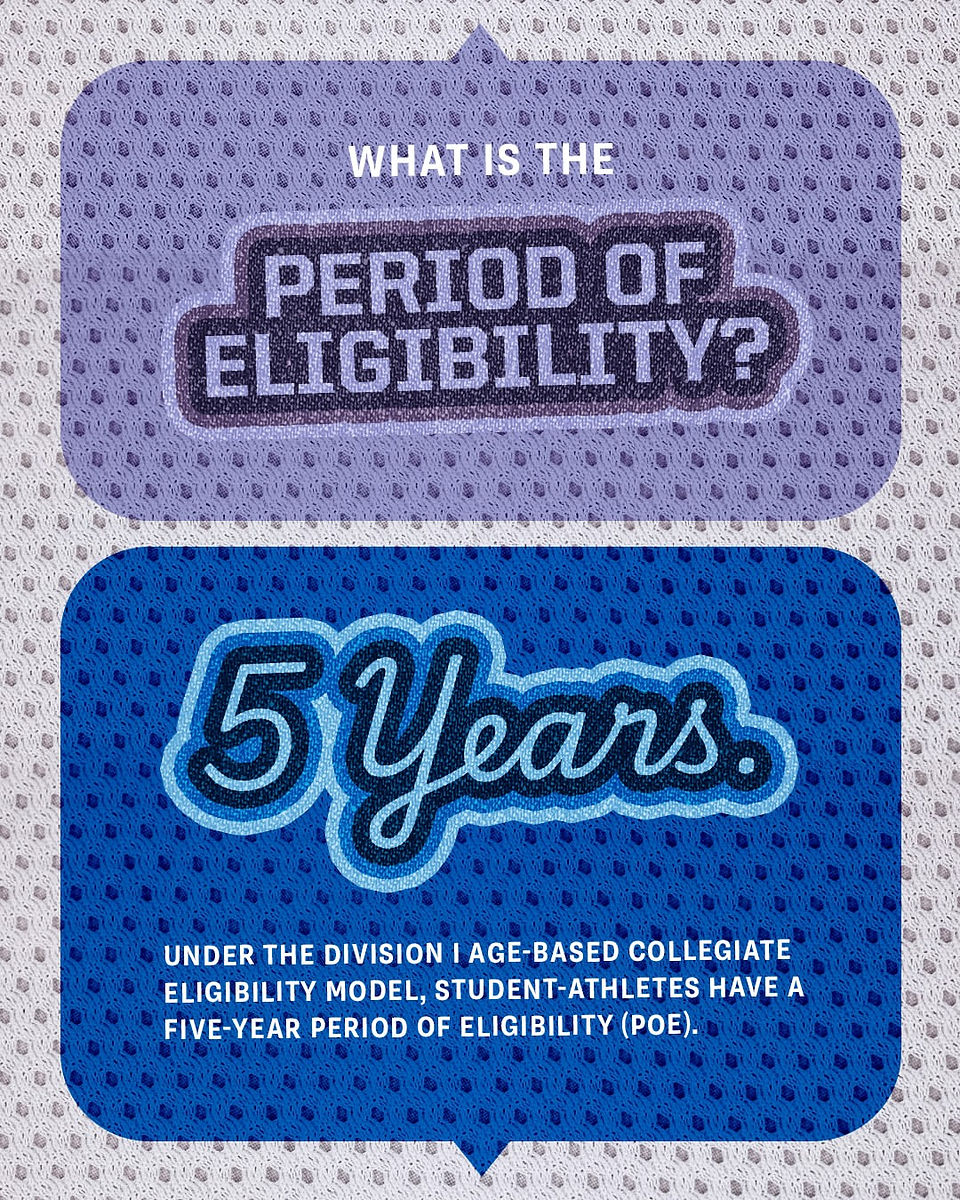
VIA NCAA INSTAGRAM 
VIA NCAA INSTAGRAM 
VIA NCAA INSTAGRAM 
VIA NCAA INSTAGRAM


Comments