%20copy.png)
From Loss to Lasting Legacy: The Story of Shoulder Check
Jul 23
7 min read
Interview by Holly Arend | July 23 2026

On a bus ride home after a bad day at school, a kid sat alone at the front, with no one beside him. Hayden Thorsen noticed.
He put a hand on his shoulder, asked if he was okay and invited him to come sit with him.
It was a small gesture, quiet and instinctive, the kind of thing that might have passed in a moment and still stayed with someone for years. In many ways, it became the kind of moment Shoulder Check was built to honor.
Reach out, check in, make contact.
Those words eventually became the heartbeat of Shoulder Check, but they started somewhere more personal. They started in the way Hayden moved through the world, in the way he noticed people, in the way he made them feel less alone.
After Hayden passed by suicide at 16, what remained for his family was not only grief, but the memory of how naturally he cared for others. What began in loss slowly became something lasting, not a slogan, but a way of carrying his impact forward.

For Rob Thorsen, Hayden’s father, that work was never only about remembering what was lost. It was about building something people could actually live with, something simple enough to carry into everyday life and meaningful enough to matter when it did.
That is why the language at the center of Shoulder Check matters so much. Reach out, check in, make contact is not just a message attached to the organization. It reflects the way Hayden lived.
“He was the kind of person who walked into a room and made people feel like they mattered,” Thorsen said.
That line says almost everything.
Hayden had a presence people noticed right away. He was big, funny, sharp, athletic and full of personality. But the quality people return to most often is not just that he stood out. It is that he made other people feel seen.
“He’s the warmest, kindest person on the planet,” Thorsen said. “Maybe they weren’t the best player on the team, but Hayden always made them feel like they were.”
That memory lives at the center of Shoulder Check. Not just the sadness of what happened, but the truth of who Hayden was.
From the beginning, the goal was never to create a traditional mental health campaign. Thorsen wanted something people could use, not just admire. Something direct. Something human. Something that could meet people where they already were.
“We wanted it to be simple, universal and something people could take with them,” he said.
That thinking shaped the organization’s language and its identity. Reach out, check in and make contact was designed to feel approachable, while the larger idea of making kindness a contact sport gave the message a natural connection to hockey without trapping it there.
“It has to be a doing thing,” Thorsen said. “It’s not enough to talk about it. You have to do it.”
That idea, action instead of just awareness, became the foundation.
Shoulder Check did not come to life in isolation. It grew through family, friends and the larger hockey community, all of them trying to turn grief into something that could help other people.

Gary Zegras was one of the people who immediately reached out and made it clear he wanted to be involved. Ben and Ashley Prentiss at Prentiss Hockey Performance, where Hayden had trained, also became important early partners.
Their facility, lined with jerseys from the athletes who trained there, became its own kind of tribute. The first jersey hanging in that space carried Hayden’s name.
From there, the vision started to sharpen.
Prentiss and his team wanted to do something tangible and suggested a game. That idea helped crystallize what Shoulder Check could be. The game became the launch point for the Shoulder Check Initiative.
The inaugural event carried the emotion of people who were still very close to the loss. Much of the crowd was, as Thorsen described it, only about one degree away from everything. It was public, emotional and deeply communal.
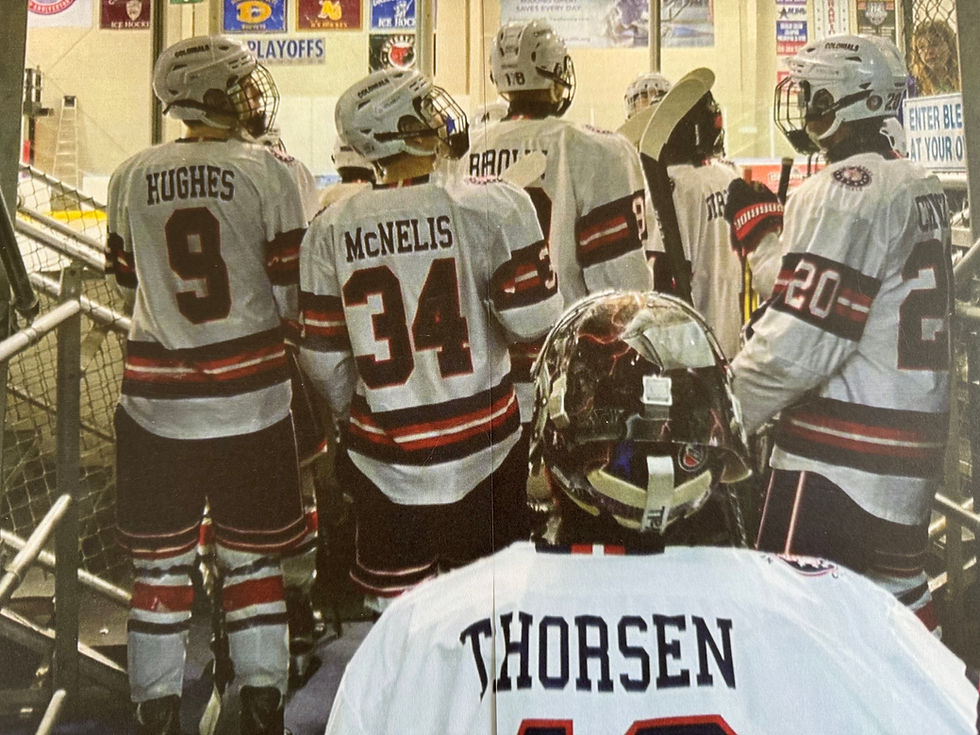
Hayden’s teammates helped run the event and skated in the amateur game, grounding it in the people and relationships that had shaped his life. Even in its earliest form, Shoulder Check felt less like a campaign rollout and more like a shared act of care.
From there, the idea kept growing.
What began as a local expression of grief and remembrance started to evolve into something larger and more portable. The core message stayed the same, but more people began to see themselves in it and bring their own energy to it.
By October 2025, Shoulder Check had already grown into a yearlong effort. Activations stretched across the NHL, the AHL, youth hockey, schools and community spaces. The initiative was no longer confined to a single event or a single room. It had become something people were carrying into their own teams, campuses and communities.
That growth also showed up creatively.
One of the clearest examples was Lean on Me, a project that brought athletes together in a way that emphasized vulnerability, trust and connection. It worked because it felt real. It did not just tell people what Shoulder Check stood for. It showed them.
The same was true as the organization moved into the next phase of its work in 2026. The calendar expanded. The activations spread. The message reached different corners of the hockey world and beyond.
There were events tied to Shattered Ice, including screenings at McGill University and with support connected to the Capitals. Other programs reached out wanting to screen the film for their students and team members. What mattered was not just that the message was growing, but that it was finding different forms.
That expansion was never really about scale for its own sake. It was about finding more ways to make the message usable.
Even as new campaigns developed and partnerships expanded, the heart of the work stayed the same. The goal was to keep Hayden’s spirit alive through action, to build a culture where kindness is practiced, not just praised.
That is part of what makes Shoulder Check feel different. It does not ask people only to agree with the message. It asks them to do something with it.
The annual showcase became the clearest expression of that idea, but it also became part of a larger rhythm. The event was no longer just a single summer gathering. It was the center of a bigger cycle, one that continued through schools, teams, community events and creative projects throughout the year.
The move to Sacred Heart marked the next chapter in that growth.
The larger venue offered more space, more resources and more ways for people to engage, while still trying to preserve what had made the earlier years special. The hope was not to outgrow the intimacy of the event, but to give it a setting that could hold everything it had become.
“It should still be everything that made it special,” Thorsen said, “just with a better setting to host it in, with more resources.”
As planning continued, that next phase came further into focus.
Ticket sales launched earlier than in previous years. Partners from earlier events returned. New ones began joining the effort. One of those partners was Be The People, whose values aligned closely with the spirit of Shoulder Check and the people behind it.
That mattered because the partnership was not just sponsorship. It was recognition.
Be The People saw in Shoulder Check the same call to action they believe in: that communities change when people choose to step up, show up and be part of something bigger than themselves.
There was also hope for the Hockey Hall of Fame to bring trophies to the event, and the possibility of broader broadcast visibility changed what the day could become.
But what seemed to excite Thorsen most was not the scale of the production. It was the opportunity to create more touch points for the message itself.

photos provided by Rob Thorsen 
photos provided by Rob Thorsen 
photos provided by Rob Thorsen
He described an experience where the event would not just contain Shoulder Check, but express it constantly. Stories on the jumbotron. Reflections from students who had helped bring the idea to life. Messages from families explaining why they check in. Moments woven into the rhythm of the day rather than forced into it.
That distinction matters.
The most moving parts of Shoulder Check have rarely felt manufactured. They work because they feel lived in. They come from real people, real stories and real acts of connection.
“There’ll be a band, there’ll be more and different food, there’ll be additional partners in our midway, there’ll be new things to see, like the Hall of Fame trophies, and of course, the players’ arrivals,” Thorsen said.
There is joy in that description, and that joy matters too.
Shoulder Check has always carried grief inside it, but it has never been built only around grief. It is also built around warmth, humor, togetherness and the belief that kindness can still be active, visible and shared.
That may be one of the clearest ways Hayden’s presence remains inside it.
The whole story matters, of course. The family knows that. The people close to the organization know that. But one of the most powerful things about Shoulder Check is that carrying the idea forward does not always require knowing every detail of where it began.

photos provided by Rob Thorsen 
photos provided by Rob Thorsen 
photos provided by Rob Thorsen
Sometimes it starts much smaller than that.
A hand on a shoulder.
A question.
An invitation to sit down beside someone.
That is the kind of memory this work keeps returning to. Not because it is sentimental, but because it is instructive. It reminds people that connection does not always have to be grand to be meaningful. Sometimes the smallest gestures leave the deepest mark.
That is what Shoulder Check was built to hold onto.
Not only the pain of losing Hayden, but the example of how he lived.
Not just awareness.
Not just remembrance.
Action.
Care.
Presence.
The choice to notice someone else and move toward them.
That is why the phrase still holds.
Reach out, check in, make contact.
It is a mission statement, but it is also more than that. It is a reflection of Hayden’s life. It is the shape his impact took after loss. It is the way his family, friends and community chose not to let kindness stop with memory.


Beautifully written.